
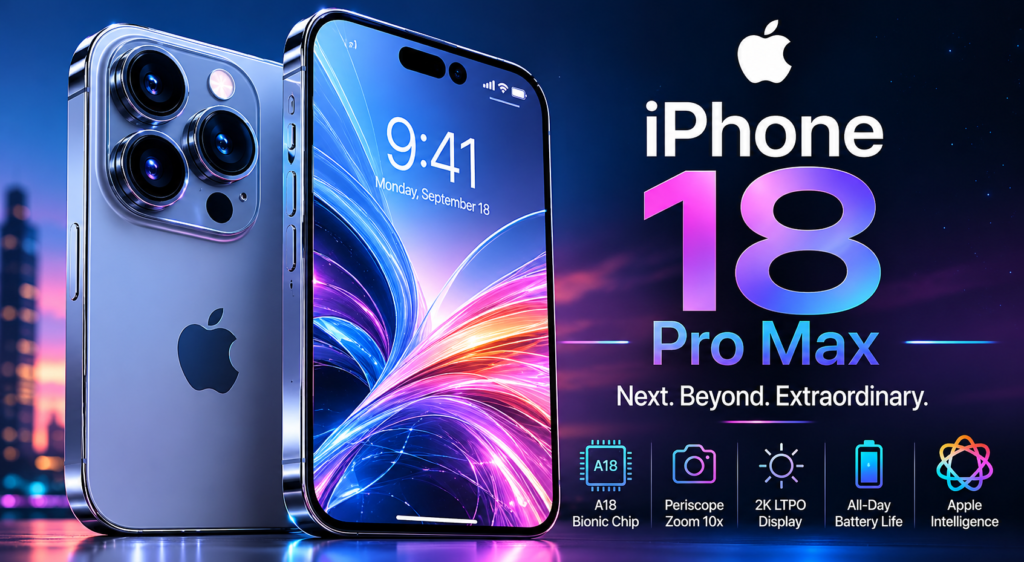
The Ultimate iPhone 18 Pro Max Blueprint: Every Leak, Spec, and Upgrade Coming in 2026
The smartphone market is standing on the precipice of its most radical hardware shift in a decade. As artificial intelligence moves from cloud-hosted novelty to on-device necessity, mobile silicon must reinvent itself. Enter the iPhone 18 Pro Max.
Expected to debut in September 2026, this flagship device represents more than an incremental yearly update. It is Apple’s first native “AI-first” super-phone, a device built from the ground up around a groundbreaking 2-nanometer processor, a mechanical variable aperture camera, and an ecosystem structurally divided to elevate premium hardware.
This comprehensive deep-dive breaks down every credible industry leak, supply chain report, and architectural milestone tracking the iPhone 18 Pro Max. From the highly debated “split-launch” retail strategy to specific battery capacities, here is your definitive look at the future of Apple mobile computing.
1. The 2026 Split-Launch Strategy: A New Retail Playbook
For over a decade, Apple’s autumn keynote followed a predictable rhythm: announce the standard and Pro model iPhones simultaneously, launch them globally within a two-week window, and let holiday sales figures break records. In 2026, supply chain indicators suggest Apple will shatter this playbook.
Expected Apple 2026–2027 Rollout Schedule:
├── September 2026 (Premium Tier)
│   ├── iPhone 18 Pro
│   ├── iPhone 18 Pro Max
│   └── iPhone Ultra / Fold
└── Spring 2027 (Entry Tier)
    ├── iPhone 18
    └── iPhone 18e
Separating Premium from Entry-Level
Reports indicate that Apple will separate its generation into two distinct release cycles. The premium tier—consisting of the iPhone 18 Pro, iPhone 18 Pro Max, and a highly anticipated foldable companion device—will claim the traditional September 2026 spotlight.
Conversely, the lower-cost standard models, tentatively designated the iPhone 18 and a budget-conscious iPhone 18e, are being held back for a Spring 2027 launch.
Why Is Apple Changing the Release Schedule?
- TSMC Production Yields: The primary bottleneck is the supply of next-generation semiconductors. By reserving early batches of cutting-edge chips for the high-margin Pro Max and Pro lines, Apple maximizes profitability while mitigating factory shortages.
- Marketing Differentiation: Grouping the Pro Max alongside a new foldable form factor keeps the autumn launch hyper-focused on luxury, productivity, and absolute peak performance.
- Sustained Fiscal Momentum: Pushing the base models to the spring prevents the post-holiday sales dip that typically occurs in quarters two and three, giving Apple a reliable secondary revenue surge.
2. Silicon Revolution: The TSMC 2nm A20 Pro Chip
At the core of the iPhone 18 Pro Max lies its most significant competitive advantage: the A20 Pro system-on-a-chip (SoC). This processor marks the commercial debut of TSMC’s 2-nanometer (2nm) production node, transitioning away from the FinFET transistor designs used for generations toward a novel GAAFET (Gate-All-Around Field-Effect Transistor) architecture.
Process Node Progress:
3nm Node (A17 Pro / A18 Pro) ──► 2nm GAAFET Node (A20 Pro)
                                  ├── +10% to 15% Raw Computing Speed
                                  └── Up to 30% Thermal/Energy Reduction
Speed and Thermal Efficiencies
By wrapping the transistor gate around all four sides of the channel, GAAFET technology drastically reduces current leakage while optimizing electronic flow. Industry data points to a 10% to 15% increase in absolute computing speed alongside an unprecedented 30% reduction in power consumption relative to previous 3nm chips. This means the iPhone 18 Pro Max can sustain intensive workloads without throttling or generating uncomfortable back-glass heat.
The 12GB Unified RAM Upgrade
To unlock the true capabilities of advanced generative models, Apple is increasing the standard memory configuration of the iPhone 18 Pro Max to 12GB of unified RAM.
Local AI models require large amounts of high-speed memory to store system parameters directly on the device. Moving from older 8GB limits to 12GB ensures the A20 Pro chip can instantly access complex text, image creation, and context-aware predictive engines without relying on an internet connection or cloud servers.
3. Display Evolution: A Smarter, Shrinking Dynamic Island
The front face of the iPhone 18 Pro Max refines the design language introduced with the iPhone 14 Pro series. While retaining the expansive 6.9-inch LTPO Super Retina XDR OLED display, Apple has achieved a massive engineering feat regarding the front sensor array.
Dynamic Island Footprint:
[==== Older Dynamic Island ====]
[== New 30% Smaller Footprint ==] -> Enabled by Metalens Proximity Tech
The Shrunken Dynamic Island
By incorporating advanced meta-lens technologies within the Face ID module, engineers have successfully compressed the physical footprint of the Dynamic Island cutout by 30% to 35% in width. This flat meta-lens structure replaces the bulky curved glass optics used previously, focusing light more efficiently in a fraction of the space. The result is a less intrusive island that frees up active pixels for videos, games, and status notifications.
Display Specifications Breakdown
- Variable Refresh Rate: 1Hz to 120Hz ProMotion technology dynamically scales down to preserve battery life when looking at static text, and ramps up during high-speed scrolling or gaming.
- Outdoor Peak Brightness: Engineered to reach up to 3,000 nits under harsh direct sunlight, maintaining total legibility.
- Substrate Durability: An updated iteration of Ceramic Shield composite glass offers structural resistance against drop fractures and micro-abrasion scratches.
4. Professional Optics: Mechanical Variable Aperture
Mobile photography has traditionally been constrained by fixed hardware lenses, forcing software algorithms to simulate background blur (bokeh) and light exposure variations. The iPhone 18 Pro Max aims to bridge the gap between smartphones and dedicated mirrorless cameras by introducing a physical mechanical variable aperture on its primary camera.
Mechanical Lens System:
  Bright Environments: Blades contract (f/2.4) -> Deep focus, sharp landscapes.
  Low-Light Scenarios: Blades expand (f/1.4)   -> Natural bokeh, max light intake.
True DSLR-Grade Light Control
Moving beyond software-generated portrait modes, the primary 48-megapixel camera sensor will integrate moving mechanical blades capable of shifting between open and closed states (expected to scale from a bright f/1.4 to f/2.4 range).
- In Low Light: The lens opens wide to f/1.4, flooding the sensor with photons to eliminate grain and shutter lag without blowing out highlight details.
- In Bright Landscapes: The lens closes down to f/2.4, expanding the depth of field so both the immediate foreground and distant background remain tack-sharp.
Complete Triple-Lens Camera Layout
| Camera Module | Resolution | Special Feature / Enhancement |
|---|---|---|
| Primary Wide | 48 Megapixel | Mechanical Variable Aperture (f/1.4 – f/2.4), 2-micron pixels |
| Ultra-Wide | 48 Megapixel | Macro capabilities down to 2cm, upgraded low-light gathering |
| Periscope Telephoto | 48 Megapixel | Quad-prism 5x physical optical zoom, enhanced sensor-shift OIS |
5. Battery and Charging: Breaking Endurance Records
Historically, maximizing smartphone battery capacity required building bulky, uncomfortably heavy chassis designs. However, thanks to improvements in energy density and cell chemistry, the iPhone 18 Pro Max delivers an impressive 5,200 mAh battery capacity while retaining its slim profile.
Battery Endurance Drivers:
┌────────────────────────────────────────┐
│      5,200 mAh Silicon-Carbon Cell     │
└───────────────────▲────────────────────┘
                    │
┌───────────────────┴────────────────────┐
│      30% Less Power Drawn via 2nm      │
└────────────────────────────────────────┘
Silicon-Carbon Anode Chemistry
By transitioning from standard lithium-ion structures to silicon-carbon anode technology, Apple can pack more power into a smaller volume. When you pair this dense 5,200 mAh hardware with the 30% power savings provided by the A20 Pro processor, the iPhone 18 Pro Max easily achieves two full days of typical operation on a single charge cycle.
Charging Protocol Specs
- Wired USB-C Charging: Upgraded support for up to 45W power delivery, refueling the cell from 0% to 70% in roughly 30 minutes.
- MagSafe Capabilities: Qi2 compliance optimized for 25W wireless charging, offering faster cable-free charging with lower heat generation.
6. Connectivity Unchained: The Custom Apple C2 Modem
For years, Apple relied on Qualcomm to supply its network modems. The iPhone 18 Pro Max marks a major turning point by introducing the Apple C2 Custom Modem, a proprietary piece of silicon built in-house to deeply integrate with the iOS system architecture.
Apple C2 Modem Feature Set:
├── Lower Battery Drain (Deep OS integration)
├── Rapid 5G Band Switching
└── Carrier-Independent Satellite Internet (Global SMS & emergency browsing)
Carrier-Independent Satellite Internet
The standout feature of the C2 modem is its expanded satellite-to-device connectivity. While earlier generations restricted satellite functions to emergency text messages or roadside tracking, the iPhone 18 Pro Max expands this to standard SMS messaging and limited internet browsing when completely outside cellular tower or Wi-Fi range.
Whether you are off-grid in the mountains or out at sea, your device can link directly with low-Earth orbit satellites to keep you connected to friends, family, and essential online tools.
7. Materials, Aesthetics, and the “Dark Cherry” Flagship Palette
Apple has refined its manufacturing processes to blur the line between distinct materials on the phone’s chassis, making the transition between the metallic perimeter and the rear panel feel seamless.
Color Profile Options (2026 Season):
 █ Dark Cherry (Premium Highlight)
 █ Light Blue
 █ Dark Gray
 █ Silver
Unified Color Manufacturing
By deploying an advanced dual-ion exchange and texturing process, Apple fuses the coloring agents deep within the matrix of the back glass. This technique matches the tone and light reflection of the matte-finished back glass with the Grade 5 Titanium frame, making the entire device look like it was carved out of a single piece of material.
The Color Palette
Leaked documentation highlights Dark Cherry—a deep, luxurious, wine-red tone—as the premium signature color for this generation [0.31]. It will sell alongside three traditional, clean color choices:
- Light Blue (a soft, icy blue tone)
- Dark Gray (a deep charcoal gray)
- Silver (a bright, polished metallic finish)
8. Storage Tiers and Expected Retail Pricing
Given the rising costs of raw materials and advanced 2nm semiconductor manufacturing, price hikes seemed inevitable. However, supply chain estimates indicate that Apple plans to absorb these early manufacturing costs to maintain its competitive edge over premium Android alternatives.
The baseline model is expected to start at $1,199 USD, offering 256GB of high-speed storage. For professional content creators shooting uncompressed 4K ProRes video, Apple will offer a 2TB storage tier, providing ample local space for demanding media workflows.
Expected Pricing Structure:
  256GB Base Tier ──► $1,199 USD
  512GB Mid Tier  ──► $1,399 USD
  1TB High Tier   ──► $1,599 USD
  2TB Master Tier ──► $1,799 USD
9. Comprehensive Comparison: iPhone 18 Pro Max vs. Predecessors
To understand how significant these cumulative changes are, look at how the iPhone 18 Pro Max compares directly to previous generations:
| Feature Specification | iPhone 16 Pro Max (2024) | iPhone 17 Pro Max (2025) | iPhone 18 Pro Max (2026) |
|---|---|---|---|
| Processor Type | A18 Pro (3nm Node) | A19 Pro (Refined 3nm) | A20 Pro (2nm GAAFET Node) |
| System Memory (RAM) | 8GB RAM | 12GB RAM | 12GB RAM (High-Bandwidth) |
| Primary Camera Lens | Fixed f/1.78 Aperture | Fixed f/1.8 Aperture | Mechanical Variable f/1.4–f/2.4 |
| Island Cutout Size | Standard Dimensions | Standard Dimensions | Compressed footprint (30% Smaller) |
| Battery Cell Capacity | 4,685 mAh | 4,852 mAh | 5,200 mAh (Silicon-Carbon) |
| Modem Silicon | Qualcomm Snapdragon | Qualcomm Snapdragon | Apple Custom C2 Hardware |
| Satellite Capability | Emergency SOS / Texting | Emergency Texting | Full SMS / General Web Browsing |
10. Summary Checklist: Is It Worth the Wait?
If you are trying to decide whether to upgrade now or wait for the autumn 2026 window, consider this quick summary checklist of what the iPhone 18 Pro Max brings to the table:
- Wait for the iPhone 18 Pro Max if:
- You want true optical, DSLR-like control over portrait blur and low-light photos.
- You need two days of reliable battery life without carrying a portable power bank.
- You frequently travel off-grid and want a phone that stays connected via satellite.
- You want maximum screen real estate with a smaller Dynamic Island cutout.
- Skip or buy an older model if:
- You want to upgrade immediately and cannot wait until late 2026.
- You prefer a standard, lower-cost base iPhone (which will face launch delays into 2027).
- You rarely use demanding features like on-device AI tools, high-end mobile gaming, or professional photography.
Frequently Asked Questions (FAQ)
When will the iPhone 18 Pro Max be officially released?
The iPhone 18 Pro Max is expected to follow Apple’s traditional autumn release schedule, with an official announcement in September 2026. However, the cheaper, standard model iPhone 18 and 18e are rumored to face delays until Spring 2027.
What is the standout camera feature on the 18 Pro Max?
The main upgrade is a mechanical variable aperture system. This allows the lens to physically expand or contract between f/1.4 and f/2.4, giving you professional, DSLR-like control over light intake and natural background blur without relying on software algorithms.
Will the iPhone 18 Pro Max offer better battery life?
Yes, dramatically so. By combining a larger 5,200 mAh silicon-carbon battery with the highly efficient 2nm A20 Pro processor, the device is expected to last up to two full days of typical use on a single charge.
What colors will be available for the iPhone 18 Pro Max?
Leaked supply chain details point to four color options: a signature Dark Cherry wine-red finish [0.31], alongside Light Blue, Dark Gray, and Silver.
How much will the iPhone 18 Pro Max cost?
The baseline 256GB storage option is expected to start at $1,199 USD, keeping the launch price consistent with previous top-tier Pro Max releases.
If you want to track how these specifications match up against other options, let me know if you would like me to compare this device to the upcoming foldable iPhone or review the latest Apple Intelligence AI features!